|
|
Some publications
|
|
|
|
|
Abs 13:
Finaev A.F. 1994.
The potential of atmospheric pollution of Tajikistan territory.
Izv. Ac. Sci. Rep. Tadzh. Dept. Sci. Ear., Issue 1, p. 69-74, (russ.).
The review and analysis of
physic-and-geographical conditions influencing
accumulation of impurity in atmosphere were done.
The sketch-map of annual
distribution of atmosphere pollution potential on the territory
of Tajikistan and sketch-maps of atmospheric pollution
distribution in various seasons were calculated.
|

|
Abs 14:
Finaev A.F.,
1994.
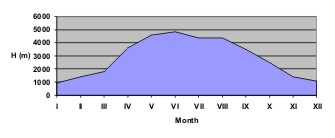
Vertical profile of diffuse radiation and year motion of the
height convection layer.
Izv. Ac. Sci. Rep. Tadzh. Dept. Sci. Ear., Issue 3, p. 59-32, (russ.).
Dependence of
diffuse
radiation vertical
profile
on optical thickness of atmosphere was investigated. Function of
boundary layer height was received and its annual motion
was calculated. The height of boundary layer varies from 950 m
a.s.l. (in winter) up to 4850 m a.s.l. (in summer).
|

|
Abs 17:
Finaev A. 1995. Processes of transportation and sedimentation of
dust aerosol. In book: Global Analysis, Interpretation, and
Modeling: First Science conference 25-29 September 1995,
Garmisch-Partenkirchen. IGBP Secretariat of Germany
in
Berlin. P-22.
Results of aerosol transportation, sedimentation and accumulation
modeling in
Tajikistan
are given.
|

|
Abs 20:
Finaev A.F. 1999. Climatic Changes in the Mountain Glacier Area
of Pamir. In NATO ASI Series I, Vol. 56. Ice Physics in the
Natural Environment. (Eds. Wettlaufer/Dash/Untersteiner).
Springer-Verlag. Berlin, Heidelberg. 289-294.
Analysis of data allows us to draw some conclusions about
climatic changes in Tajikistan and their connection to the
changes of the global climate. (a) Annual air temperatures show
a steady increase at all levels from 400 to 4000 m (a.s.l.). (b)
The rate of air temperature increase on the plain stations is
greater than in the high mountains. (c) The vertical gradient of
temperature increases with time and leads to increased
atmospheric mixing. (d) The cold half of the year warms up more
than the warm half. (e) Precipitation increases in mountain
areas more than in the valleys. (f) Precipitation increases more
in the cold half of the year than in the warm half. (g) In
valleys, a reduction in precipitation occurs in May, and all
stations show a reduction in June. (h) Climate warming has
caused of some of Pamir’s glaciers to recede.
|

|
Abs 21:
Finaev A.F., Sosin P.M. 1999. Soils with Mediterranean Type of
Climate: East Part of Central Asia. 6th
International Meeting on Soils with Mediterranean Type of
Climate. 4-9 July 1999. Barcelona. (Ed. J. Bech). University of
Barcelona. 415-417.
|

|
Abs 22:
Finaev A.F. 1999. Research opportunities of climatic changes in
Tajikistan. In Book: Geosciences in High Asia. Proceedings of
a symposium held in Dushanbe (10-11 October 1998) on occasion of
the 70th anniversary of the German-Soviet Alai-Pamir
expedition in 1928. Edited by W. Zech and AS Republic of
Tajikistan. Band 65. Bayreuth, 1999. |

|
Abs 28:
Finaev A. Transportation and Sedimentation of Dust Aerosol in
Tajikistan. In Book: Pamir and Tian Shan: Glacier and Climate
Fluctuations during the Pleistocene and Holocene. International
Workshop. July 22-23, 2000. Bayreuth, 2000.
Analysis of geographical
and climatic data and the results of different researches allowed
us to make 3D model of dust particles sedimentation in loess formation
region.
|

|
Abs
34:
Glazirin
G.E.,
Finaev F.A. 2003.
The forecast of mountain glaciation change in Western
Tajikistan.
The future glaciosphere in requirements of varying climate.
The workshop of glaciological association. Pushchino,
Moscow area,
17-21
may
2002.
MGR Moscow.
2003,
V
95,
p.
102-106.
One of the important glaciological problems is to estimate
possible glaciation change in different mountainous countries.
It is forced by forecast of rather considerable climate changes.
Glaciarization change in three river basins of Western
Tajikistan is calculated in proposing report. The calculations
were made for two tributaries of Zeravshan River - Matcha River
and Fandarya River, and for well-studied Varzob River basin.
Selection of these basins was prompted by the fact that they are
located on different sides of Hissar Range.
|

|
Abs 36:
Finaev A.F.
2003.
Conditions of water resources formation. In book: Reports Ac.
Sci. Rep.
Tadzh.
Vol.
XLVI,
Issue
11-12,
p.
40-51.
The article describes natural factors of water resources
formation,
climate and glaciation in Tajikistan.
Glaciation change alternatives under the influence of climate
changes are examined.
|

|
Abs
41:
Sosin P.M.,
Finaev A.F.
2004.
Climatic conditions of Mediterranean subtropical soil formation.
Archeology and
palaeoecology
of Eurasia. Novosibirsk: Institute of archeology and ethnography
of the Siberian Branch of the Russian Academy of Science, p.
348-350, (russ.).
Conditions of Mediterranean subtropical soil formation in
connection with climate change are discussed in the article.
|

|
Abs
42:
Finaev A.F. 2004. Model of dust aerosol transportation and
sedimentation in southern areas of Tajikistan. Archeology and
palaeoecology of
Eurasia. Novosibirsk: Institute of archeology and ethnography of
the Siberian Branch of the Russian Academy of Science, p.
351-358, (russ.).
3D model for calculation of aerosol sediments thickness in the
field of loess formation is given. Results of calculations show
that the thickest accumulation layer is formed in southern areas
and reaches 0.5-0.6 mm/year. Average dust accumulation layer in
Tajikistan makes 0.2 mm/year. This value agrees to loess
sections records of early Holocene.
|

|
Abs
43:
Finaev A.F. 2004. Assessment of climatic conditions
influence
on labour activity of the human. Archeology and
palaeoecology Eurasia.
Novosibirsk: Institute of archeology and ethnography of the
Siberian Branch of the Russian Academy of Science, p. 359-372, (russ.).
The estimation of comfort and labour capacity change in mountain
conditions was made in connection with climate change forecast
according various models. 4 scenarios of climate change were
used: CCC-EQ, UK-TR, GFDL-TR and Had CM2
|
 |
Abs 45: Finaev A.F. 2004.
Climate and glaciation. Water resources of the Central Asia.
Dushanbe: Institute of Water Issues, Hydropower Engineering
and Ecology, Academy of Sciences, v. 1, ¹ 1. pp. 55-65. (rus.)
(370 kb.)
Issues of climate impact on glaciation of mountain areas in
Tajikistan are considered in the article. Prediction of glacial
change
related to climate change depends on used climatic model.
Therefore, it is not correct to speak about degradation of
glaciers in Tajikistan due to climate warming-up without
profound researches and regular observation in this area.. |

|
Abs 46: Finaev A.F. 2005. On
research of glaciation in the Central Asia. Water resources of
the Central Asia. Dushanbe: Institute of Water Issues,
Hydropower Engineering and Ecology, Academy of Sciences, ¹ 2.
pp. 70-80. (rus).
(1114 kb.)
The article discusses the problems of Central Asia climate
study. Ambiguity of glacial change estimations proves this issue
is far from being solved. |
 |
Abs 50: Finaev A., 2009.
Review of hydrometeorological observations in Tajikistan for the
period of 1990-2005. In book: Joint Publication of UNESCO-IHP
and the German National Committee for IHP/HWRP. Selected papers
from the Workshop “Assessment of Snow, Glacier and Water
Resources in Asia” held in Almaty, Kazakhstan, 28-30 Nov. 2006.
edited by Ludwig N. Braun, Wilfried Hagg, Igor V. Severskiy and
Gordon Young. IHP/HWRP-BERICHTE, Heft 8. Koblenz. 55-64.
(1225 kb.)
This article describes functioning of the hydrometeorological
network and the tendency of hydrometeorological parameters from
1990 until 2005. |
 |
Abs 52: Vladimir B. Aizen, Paul
A. Mayewski, Elena Aizen, Daniel Joswiak, Arzhan Surazakov,
Susan Kaspari, Bijorn Grigholm, Michael Krachler, Mike Handley,
Alexander Finaev.
2009. Stable-isotope and trace element time series from
Fedchenko glacier (Pamir) snow/firn cores. Journal of
Glaciology, Vol. 55, No. 190, 2009. 275-291.
(1038 kb.)
Results of the snow--firn sampling analysis are represented in
the abstract. The samples were taken in the upper course of
Fedchenko glacier at the altitudes of 5365 and 5206 m. above
sea-level. Ways of aerosol particles transportation into glacial
areas of the Pamir are also discussed. |
 |
Last updated:
© 2005, , Alexander Finaev Studio.
F-Lab
[
Top
]
|
|